Resource Library - EASA | The Electro•Mechanical Authority
Facebook Twitter LinkedIn YouTube Menu Search Arrow Right Arrow Left Arrow Down Arrow Up Home Arrow Next Arrow Previous RSS Icon Calendar Icon Warning Icon

Filter the results

  • Enter one or more words to find resources containing any of the words entered
  • Enter words or phrases between " " to find exact match

Resource categories

Resource Library

Powering What’s Next: Why the Motor Service Industry Matters More Than Ever

  • April 2026
  • Number of views: 277
  • Article rating: 5.0
Article

Right now, electric utilities across North America are spending money like never before – and that investment is driving one of the biggest infrastructure buildouts we’ve ever seen. But here’s the thing: behind every new substation, data center and transmission line is another part of the story – the people and companies, especially within EASA, that repair, rebuild and maintain the motors, generators, transformers and associated switchgear that keep it all running. That’s the electromechanical side of the business, and it’s about to get a lot busier.

Artificial Intelligence: What It Can Do, What It Can’t Do and Where to Start

  • April 2026
  • Number of views: 237
  • Article rating: 4.0
Article

Artificial intelligence has quickly become one of the most talked-about technologies across every industry, including the electromechanical world. Depending on who you listen to, AI is either going to replace engineers and technicians, or it is just another overhyped tech trend. As is often the case, the reality sits somewhere in the middle. 

AI Adoption in EASA Service Centers: What the Survey Tells Us

  • April 2026
  • Number of views: 298
  • Article rating: 4.0
Article

Artificial intelligence is one of the most talked about technologies in industry right now, but how much of it is actually being used inside EASA member companies? To better understand this, the Emerging Technologies Committee recently surveyed the membership about AI adoption in service centers.

Repair-vs.-Replace Discussions Need to Be Grounded in Evidence

  • April 2026
  • Number of views: 121
  • Article rating: No rating
Article

The repair/replace conversation should be built on facts, not feelings. Customers respect recommendations that are based on clear, technical, logical and economic reasoning.  A simple framework helps keep the discussion professional instead of emotional. 

Temperature Detecting Accessories

  • March 2026
  • Number of views: 788
  • Article rating: No rating
FREE for Members of EASA
Webinar recording

When equipment fails and customers wait, knowing exactly how to test each temperature-sensing device becomes critical. Don't let temperature accessories be your diagnostic blind spot.

From Search Results to Recommendations: How AI is Redefining Visibility for Businesses

  • March 2026
  • Number of views: 1027
  • Article rating: No rating
Article

For decades, digital visibility meant mastering search engine optimization. But it no longer tells the whole story. AI-driven search systems operate by new logic.

Practical Use of Leadership Concepts and Emotional Intelligence That Resonate with Electromechanical Professionals

  • February 2026
  • Number of views: 1028
  • Article rating: No rating
Article

Emotional intelligence is simply the ability to recognize, understand and manage your own emotions— and to recognize and respond to the emotions of others. When leaders grasp this side of their teams, performance improves—but more importantly, people grow. They become problem-solvers instead of task-doers. They become the next generation of leaders.

Fan Laws and System Resistance Curves

  • January 2026
  • Number of views: 1137
  • Article rating: No rating
Article

The purpose of this article is to explain the basis and application of rules used to “estimate” fan performance for a fan installed in a duct system moving air when the speed of the fan is changed.

Leyes de los ventiladores y curvas de resistencia del sistema

  • January 2026
  • Number of views: 513
  • Article rating: No rating
Article

El propósito de este artículo es explicar los fundamentos y la aplicación de las reglas utilizadas para estimar el rendimiento de un ventilador instalado en un sistema de conductos que mueve aire al variar su velocidad. Con un conocimiento básico de estas reglas, es posible calcular rápidamente el rendimiento de un ventilador para diversas condiciones de velocidad.

Transitioning Electric Motor Repair Shop Managers

  • November 2025
  • Number of views: 1615
  • Article rating: No rating
Article

A thoughtful succession plan—such as hiring a new manager one year before the retirement of the veteran employee—can turn the process of leadership transition into a positive, future-focused evolution.

Getting The Most From Your Electric Motors

Getting The Most From Your Electric Motors - coverThis 40-page booklet provides great advice for obtaining the longest, most efficient and cost-effective operation from general and definite purpose electric motors.

This booklet covers topics such as:

  • Installation, startup and baseline information
  • Operational monitoring and maintenance
  • Motor and baseline installation data
  • How to read a motor nameplate
  • Motor storage recommendations

LEARN MORE AND DOWNLOAD MÁS INFORMACIÓN Y DESCARGAR BUY PRINTED COPIES

READ MORE ABOUT THE FEATURES AND BENEFITS

EASA/AEMT Rewind Study

EASA Rewind Study cover

The Effect of Repair/Rewinding on Premium Efficiency/IE3 Motors
Tests prove Premium Efficiency/IE3 Motors can be rewound without degrading efficiency.

DOWNLOAD THE FULL RESULTS

ANSI/EASA AR100-2025

ANSI/EASA AR100-2025 cover

Recommended Practice for the Repair of Rotating Electrical Apparatus
This is a must-have guide to the repair of rotating electrical machines. Its purpose is to establish recommended practices in each step of the rotating electrical apparatus rewinding and rebuilding processes.

DOWNLOAD - ENGLISH

DESCARGAR - ESPAÑOL

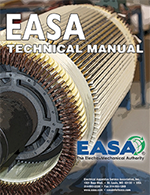
EASA Technical Manual

EASA Technical Manual cover

Revised October 2025
The EASA Technical Manual is the association's definitive and most complete publication. It's available FREE to members in an online format. Members can also download PDFs of the entire manual or individual sections.

VIEW & DOWNLOAD