Resource Library - EASA | The Electro•Mechanical Authority
Facebook Twitter LinkedIn YouTube Menu Search Arrow Right Arrow Left Arrow Down Arrow Up Home Arrow Next Arrow Previous RSS Icon Calendar Icon Warning Icon

Filter the results

  • Enter one or more words to find resources containing any of the words entered
  • Enter words or phrases between " " to find exact match

Resource categories

Resource Library

Identifying Unmarked Leads in 12-Lead Machines with One Winding

  • December 2025
  • Number of views: 281
  • Article rating: No rating
Article

Identifying unmarked leads in three-phase motors is a common task for service center technicians. This article provides one way to assign lead numbers for a 12-lead machine with unmarked leads.

Soft Foot: A Small Space With a Big Consequence

  • December 2025
  • Number of views: 99
  • Article rating: No rating
Article

Have you ever been out at a restaurant or sports bar to meet up with some friends and colleagues to have an adult beverage or two when suddenly someone leans on the table ever so slightly and liquid spills everywhere? What just happened? The small space between the table leg and the floor has just created a big consequence. While it’s not too difficult to solve if you have some napkins and a few coasters, it does, however, illustrate the results of a soft foot and how a very small space can lead to a much larger consequence.

Resolving Phantom Oil Leaks in Vertical Machines

  • November 2025
  • Number of views: 597
  • Article rating: No rating
Article

A tilted or improperly sized oil standpipe can allow oil to migrate upward along the pipe’s wall when the motor is in operation, leading to leakage, loss of lubrication and potential bearing damage. This issue can be overlooked during assembly or inspection, but a few simple checks can prevent costly problems. 

Three-phase Motor “Rules of Thumb”

  • October 2025
  • Number of views: 1301
  • Article rating: 2.7
Article

Often when we are dealing with three-phase squirrel cage motors we ask ourselves “Is there a standard or a rule of thumb for this motor characteristic?” The 10 characteristics that follow apply to conditions associated with motor starting as well as steady state operation. Examples are provided for each of the characteristics.

Motores trifásicos:“Reglas Generales”

  • October 2025
  • Number of views: 519
  • Article rating: No rating
Article

A menudo, cuando trabajamos con motores trifásicos jaula de ardilla, nos preguntamos: "¿Existe una norma o regla general para esta característica del motor?". Las siguientes 10 características aplican tanto al arranque del motor como al funcionamiento en estado estacionario.

Vertical Motor End Play

  • August 2025
  • Number of views: 1919
  • Article rating: No rating
Webinar recording

This recording provides an overview of common different thrust bearing arrangements, with end play guidance tips for each.

Rewind Tips for Two-speed, Two-Winding Hoist Motors

  • August 2025
  • Number of views: 1605
  • Article rating: 5.0
Article

Concentric to lap winding conversions are common practice in many EASA service centers. For most stators, this change is feasible and can be made with little difficulty. In some cases, however, it can be quite challenging and result in undesired outcomes due to reduction in copper or insulation.

Consejos para Rebobinar Motores de Grúas de Dos Velocidades con Dos Devanados

  • August 2025
  • Number of views: 967
  • Article rating: 5.0
Article

Las conversiones de devanados concéntricos a imbricados son una práctica común en muchos centros de servicio de EASA y en la mayoría de los estatores, este cambio es factible y se puede realizar sin dificultad. Sin embargo, en algunos casos, puede resultar muy complicado y generar resultados no deseados debido a la reducción del cobre o la pared de aislamiento.

Performing a Single-Phase Rotor Test on an Assembled Three-Phase Induction Motor

  • May 2025
  • Number of views: 3942
  • Article rating: No rating
Video

The video provides a comprehensive guide on performing a single-phase rotor test on a three-phase squirrel cage motor to check for open rotor bars.

Rewind Tips For 2300-Volt, Random-Wound Motors

  • May 2025
  • Number of views: 2345
  • Article rating: No rating
Article

From the manufacturer’s perspective, a random-wound, 2300-volt motor represents a substantial reduction in manufacturing cost. For the service center, the challenge is to successfully rewind them while providing a reliable repair. Here are some techniques which will enhance your success rate.

Getting The Most From Your Electric Motors

Getting The Most From Your Electric Motors - coverThis 40-page booklet provides great advice for obtaining the longest, most efficient and cost-effective operation from general and definite purpose electric motors.

This booklet covers topics such as:

  • Installation, startup and baseline information
  • Operational monitoring and maintenance
  • Motor and baseline installation data
  • How to read a motor nameplate
  • Motor storage recommendations

LEARN MORE AND DOWNLOAD MÁS INFORMACIÓN Y DESCARGAR BUY PRINTED COPIES

READ MORE ABOUT THE FEATURES AND BENEFITS

EASA/AEMT Rewind Study

EASA Rewind Study cover

The Effect of Repair/Rewinding on Premium Efficiency/IE3 Motors
Tests prove Premium Efficiency/IE3 Motors can be rewound without degrading efficiency.

DOWNLOAD THE FULL RESULTS

ANSI/EASA AR100-2020

ANSI/EASA AR100-2015 cover

Recommended Practice for the Repair of Rotating Electrical Apparatus
This is a must-have guide to the repair of rotating electrical machines. Its purpose is to establish recommended practices in each step of the rotating electrical apparatus rewinding and rebuilding processes.

DOWNLOAD - ENGLISH

DESCARGAR - ESPAÑOL

EASA Technical Manual

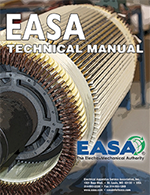
EASA Technical Manual cover

Revised May 2024
The EASA Technical Manual is the association's definitive and most complete publication. It's available FREE to members in an online format. Members can also download PDFs of the entire manual or individual sections.

VIEW & DOWNLOAD