Structuring Service Center Success With a Written Learning Plan - Resource Library - EASA | The Electro•Mechanical Authority
Facebook Twitter LinkedIn YouTube Menu Search Arrow Right Arrow Left Arrow Down Arrow Up Home Arrow Next Arrow Previous RSS Icon Calendar Icon Warning Icon
NOTICE: The EASA website will be down for maintenance beginning at 6:00 am CST, Wednesday, January 28, and will remain offline for approximately 2 hours.

Filter the results

  • Enter one or more words to find resources containing any of the words entered
  • Enter words or phrases between " " to find exact match

Resource Library

Article

Structuring Service Center Success With a Written Learning Plan

  • January 2026
  • Number of views: 419
  • Article rating: No rating

Karl Hedlund, MSEM
Management Services Committee Member
AtlasElektro
Richmond, Virginia 

Does your electric motor service center have prescribed standard operating procedures? When we hire a new team member, we load them up with policy, safety and procedural manuals, often including resources like ANSI/ EASA Standard AR100-2020. Yet, when I speak with many service center owners and managers, I often find a disconnect when it comes to formal skill development programs, such as EASA’s Electromechanical Repair Technician (ERT) Program. Many owners and managers tell me it’s left entirely up to the team member to complete on their own time and at their own direction. 

I can tell you I have tried it all—from dangling the financial carrot to selling opportunities for advancement. While some are motivated by money and upward mobility, others just want stability and clear expectations from leadership. Regardless of what drives individual workers, our obligation to our team and our customers is to optimize organizational efficiency and sell a premium value proposition.

Image
The reality is that a better-trained workforce offers a superior value to our customers and attracts better talent. A written, structured learning plan is the single most effective way to reduce downtime and inefficiency in the learning path. Rather than leaving it to each new hire to reinvent the education wheel, why not provide a formalized blueprint based on best practices and lessons learned from the struggles of previous team members? 

A written learning plan is a professional roadmap, replacing the haphazard "learn-as-you-go" method with a targeted, efficient progression of technical competency. The learning plan guarantees that training resources are invested effectively, leading to a faster return on investment for the employer and more relevant, timely skills for the employee. 

While the specific details should be tailored to your service center’s needs, here is a sample structure we use at AtlasElektro to standardize our introductory training: 

The other essential element of a written learning plan is accountability. Without accountability, a detailed plan is no more valuable than a standard that lacks a quality control component. At AtlasElektro, our goal is to improve the customer experience by ensuring that the service they receive is consistent and reliable over time. Likewise, our new hires benefit from a consistent and reliable training process that has predictability and a proven track record of success. 

The great news is that EASA’s ERT Certificate Program has already created the roadmap. For service center owners and managers, it is simply a matter of adopting this existing, robust program and determining the concrete timeline you are willing to put in writing for your candidates. This commitment transforms abstract standards into a predictable path to proficiency.

Timeline Focus Area & Key Resource Goal/Milestone
Days 1-5 Safety Training EASA Vo-Tech Volume 1 & Company Safety Manual
Days 6-30 Facilities & Basic Safety Learn PPE & Basic Equipment Shut-off Safety
Days 31-60 Shop Operations Inbound, Outbound, and Materials Handling Procedures
Days 61-62 Basic Shop Skills I EASA Vo-Tech Volume 2
Days 63-64 Basic Electricity I EASA Vo-Tech Volume 4
Days 64-65 Basic Mechanics I EASA Vo-Tech Volume 6
MILESTONE: ERT Phase I Must be Completed by Day 90 (Introductory Period)


Tags: Training
Rate this article:
No rating
Print


PREVIOUS ITEM

Getting The Most From Your Electric Motors

Getting The Most From Your Electric Motors - coverThis 40-page booklet provides great advice for obtaining the longest, most efficient and cost-effective operation from general and definite purpose electric motors.

This booklet covers topics such as:

  • Installation, startup and baseline information
  • Operational monitoring and maintenance
  • Motor and baseline installation data
  • How to read a motor nameplate
  • Motor storage recommendations

LEARN MORE AND DOWNLOAD MÁS INFORMACIÓN Y DESCARGAR BUY PRINTED COPIES

READ MORE ABOUT THE FEATURES AND BENEFITS

EASA/AEMT Rewind Study

EASA Rewind Study cover

The Effect of Repair/Rewinding on Premium Efficiency/IE3 Motors
Tests prove Premium Efficiency/IE3 Motors can be rewound without degrading efficiency.

DOWNLOAD THE FULL RESULTS

ANSI/EASA AR100-2025

ANSI/EASA AR100-2025 cover

Recommended Practice for the Repair of Rotating Electrical Apparatus
This is a must-have guide to the repair of rotating electrical machines. Its purpose is to establish recommended practices in each step of the rotating electrical apparatus rewinding and rebuilding processes.

DOWNLOAD - ENGLISH

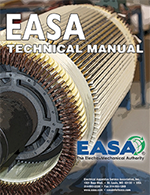
EASA Technical Manual

EASA Technical Manual cover

Revised October 2025
The EASA Technical Manual is the association's definitive and most complete publication. It's available FREE to members in an online format. Members can also download PDFs of the entire manual or individual sections.

VIEW & DOWNLOAD