Jonathan Robinson
Technical Education Committee Member
Burford Electric Service, Inc.
Oil-lubricated vertical motors rely on a properly sized, sealed and aligned oil standpipe (Figure 1) to maintain lubrication levels without leakage. A tilted or improperly sized oil standpipe can allow oil to migrate upward along the pipe’s wall when the motor is in operation, leading to leakage, loss of lubrication and potential bearing damage. This issue can be overlooked during assembly or inspection, but a few simple checks can prevent costly problems.
- Leak Check – Elevate the motor’s endbell on risers, and place brown butcher paper below the standpipe area. Fill the endbell with mineral spirits and let it sit overnight if time permits. Check the paper for oil drips. If necessary, reseal the standpipe.
- Visual Inspection – Check for threading on the inside diameter (ID) of the motor’s bearing carrier (Figure 2) or the outside diameter (OD) of the standpipe that can cause oil to climb the standpipe when the machine is in operation.
- Confirm standpipe seating – The standpipe should be fully and evenly seated in the motor’s endbell. Uneven seating can create a tilt and lead to leaks under operating conditions.
- Checking for standpipe tilt – If a coordinate measuring machine (CMM) is not available, an ID micrometer can be used to check for standpipe tilt. Using the ID micrometer, technicians can measure the distance between the OD of the standpipe and the inside of the motor’s endbell at four locations 90 degrees apart to verify that the oil standpipe is not tilted. A smaller measurement in any of these four coordinates indicates that the standpipe is tilted in that direction. Ideally, the measurements would be within 0.005” (0.13mm) of one another.
- Check the inside of the bearing carrier skirt for taper - If the upper part of the clearance is larger than the bottom, it will pump oil upwards. One tip is to machine the inside of the skirt so that it is 0.020” (0.51mm) larger at the bottom than the top.
- Standpipe clearance to shaft umbrella fit – Capillary effect can draw oil over the motor’s standpipe if the clearance between the OD of the standpipe and the ID of the shaft umbrella fit is too close. This problem is most likely to show up when the motor has had the standpipe replaced. The minimum clearance that we typically like to see between these parts is 0.030” (0.76mm) to the side.
Taking a few minutes to verify oil standpipe alignment during assembly or inspection can save hours of downtime, prevent messy oil leaks and extend bearing life. This small step is a big part of reliable vertical motor operation.
|
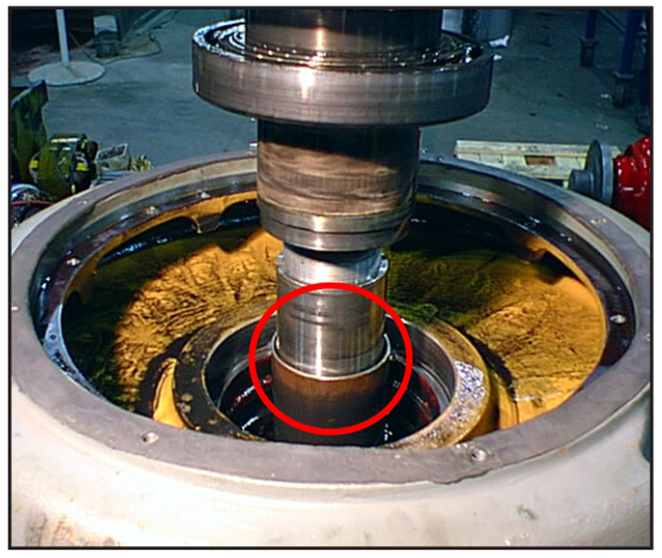
Figure 1: Standpipe shown, circled.
|
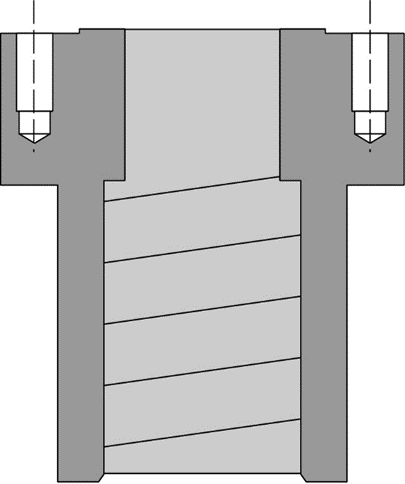
Figure 2: Even a light machined thread inside the bearing carrier acts as an Archimedes screw, the crudest form of a pump. It can lift oil from the sump to where the bearing carrier fits on the shaft, causing leakage.
|
